




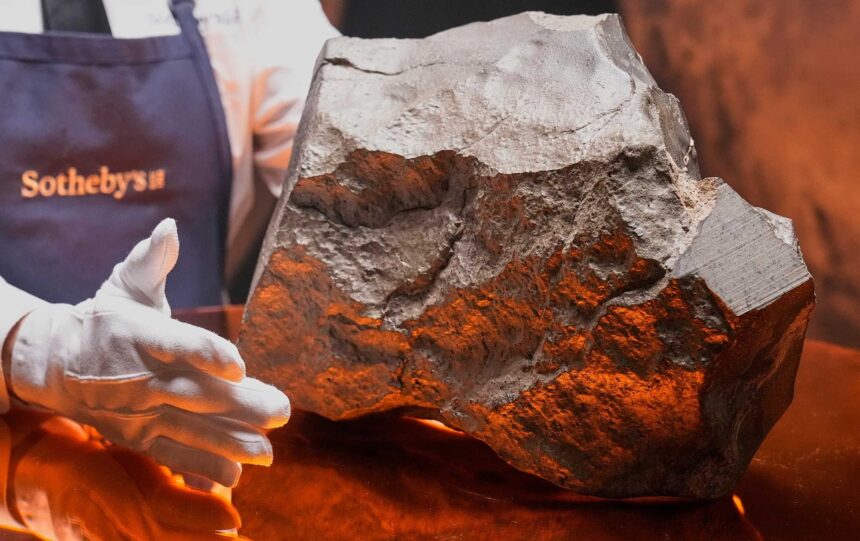
NEW YORK — A 54-pound (25-kilogram) Martian meteorite, considered the largest fragment of Mars ever discovered on Earth, is scheduled to be auctioned this week in New York. Sotheby’s has estimated the rock’s value at between $2 million and $4 million.
The meteorite, officially designated NWA 16788, will be auctioned Wednesday as part of a natural history-themed sale at Sotheby’s. The event will also feature a mounted skeleton of a young Ceratosaurus dinosaur, which stands over six feet tall and measures nearly 11 feet (3 meters) in length.
According to Sotheby’s, NWA 16788 is believed to have originated from Mars after a powerful asteroid impact ejected the rock from the planet’s surface. It then traveled an estimated 140 million miles (225 million kilometers) before landing in the Sahara Desert. The meteorite was found by a hunter in Niger in November 2023.
Composed of red, brown, and gray hues, the rock measures approximately 375 millimeters by 279 millimeters by 152 millimeters (roughly 15 inches by 11 inches by six inches). Sotheby’s states that it is around 70% larger than the next biggest known Martian meteorite fragment and represents nearly 7% of all verified Martian material currently on Earth.
“This Martian meteorite is by far the largest fragment of Mars that we’ve found,” said Cassandra Hatton, Sotheby’s Vice President of Science and Natural History. “It’s more than twice the size of what we previously thought was the largest fragment of Mars.”
Martian meteorites are rare. Out of more than 77,000 officially classified meteorites discovered on Earth, only about 400 are confirmed to have come from Mars, according to Sotheby’s.
A small sample of the meteorite was analyzed in a specialized laboratory to verify its Martian origin. It was matched against the unique chemical composition identified in Martian samples by the Viking lander, which conducted scientific operations on Mars beginning in 1976.
The specimen has been classified as an “olivine-microgabbroic shergottite,” a type of Martian igneous rock formed through the slow cooling of magma. It features a coarse-grained texture and contains the minerals pyroxene and olivine. Sotheby’s also noted the meteorite’s glossy exterior, attributed to the intense heat it endured during its descent through Earth’s atmosphere—an early clue that the rock was not of terrestrial origin.
Before the upcoming auction, the meteorite was on public display at the Italian Space Agency in Rome. Sotheby’s has not disclosed the current owner. While the exact date of the meteorite’s fall to Earth remains uncertain, scientific analysis suggests it likely occurred within recent years.
Also featured in Wednesday’s auction is the fossilized skeleton of a Ceratosaurus nasicornis, a predatory dinosaur from the Late Jurassic period, approximately 150 million years ago. The remains were discovered in 1996 near Laramie, Wyoming, at the Bone Cabin Quarry, a site known for its rich deposits of dinosaur fossils.
Experts assembled the skeleton from nearly 140 fossil bones supplemented with sculpted materials to complete the display. It is expected to fetch between $4 million and $6 million at auction. The specimen was acquired in 2024 by Fossilogic, a fossil preparation and assembly company based in Utah.
Ceratosaurus dinosaurs were bipedal carnivores with short forelimbs and are often compared in appearance to the larger Tyrannosaurus rex. While T. rex could grow up to 12 meters (40 feet) in length, Ceratosaurus specimens typically reached up to 7.7 meters (25 feet).
The auction is part of Sotheby’s “Geek Week 2025,” a series highlighting 122 items that include meteorites, fossils, and gem-quality minerals.