

Techoreon

  • Home
  • AI
  • Tips & Tricks
  • Info
    • Privacy Policy
    • DMCA & Copyright Notice
    • Contact Us
    • About Us
    • Cookie Policy
    • Terms and Conditions
Notification Show More
Latest News
Attackers Exploit ChatGPT and Grok to Push AMOS Malware to Macs
Cybercriminals Exploit ChatGPT and Grok Chats to Spread AMOS Malware to Macs
Cybersecurity
NASA Loses Contact with MAVEN Mars Orbiter After 11 Years in Operation
Astronomy
McDonald’s removed a 45-second AI-generated festive advert depicting holiday mishaps after strong negative feedback from viewers.
McDonald’s Pulls AI-Generated Christmas Ad After Viewers Mock ‘Creepy’ Footage
AI
OpenAI, Anthropic and Block Unite to Launch ‘Agentic AI Foundation’ to Set Standards for AI Agents
OpenAI, Anthropic and Block Unite to Create the ‘Agentic AI Foundation’ to Set Standards for AI Agents
AI Programming
Artist’s impression of high-speed gas being expelled from the centre of a supermassive black hole.
Black Hole Ejects Winds at 20% Light Speed in Solar-Like Magnetic Event
Astrophysics
Aa

Techoreon

Aa
  • Home
  • AI
  • Tips & Tricks
Search
  • Home
  • Privacy Policy
  • Contact Us
  • About Us
  • Cookie Policy
  • Terms and Conditions
  • DMCA & Copyright Notice
Follow US
Techoreon > Astrophysics > Black Hole Ejects Winds at 20% Light Speed in Solar-Like Magnetic Event
Astrophysics

Black Hole Ejects Winds at 20% Light Speed in Solar-Like Magnetic Event

Anita Sen
Last updated: 2025/12/09 at 2:46 PM
Anita Sen
Share
5 Min Read
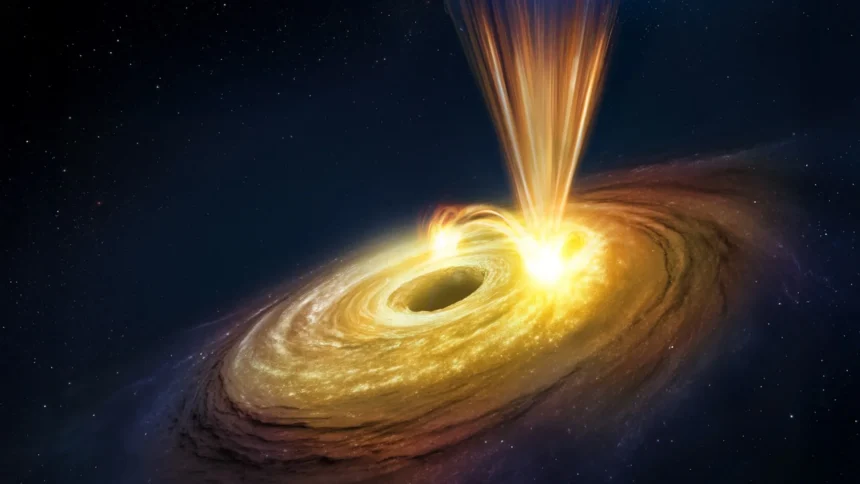
Artist’s impression of high-speed gas being expelled from the centre of a supermassive black hole.
Artist’s impression of high-speed gas being expelled from the centre of a supermassive black hole. | Credit: ESA
SHARE

For the first time, astronomers have watched a super-massive black hole produce winds reaching 20 per cent of the speed of light within hours of an X-ray flare—behaviour almost identical to a solar coronal mass ejection, a massive burst of plasma and magnetic field released from the Sun’s corona.

The outburst occurred in July 2024 in the core of galaxy NGC 3783, 130 million light-years away. ESA’s XMM-Newton and Japan’s XRISM spacecraft recorded a sharp spike in hard X-rays, followed within 12 hours by the appearance of gas racing outward at roughly 60,000 km s⁻¹ (about 57,000 km s⁻¹ in the earlier analysis). The wind persisted for three days before fading.

Lead author Liyi Gu (SRON Netherlands) says magnetic-field reconnection—similar to the process that triggers solar flares—appears to have powered the event. “We’ve seen how a rapid burst of X-ray light immediately triggers ultra-fast winds, forming in just a single day,” Gu notes. The study appears in Astronomy & Astrophysics.
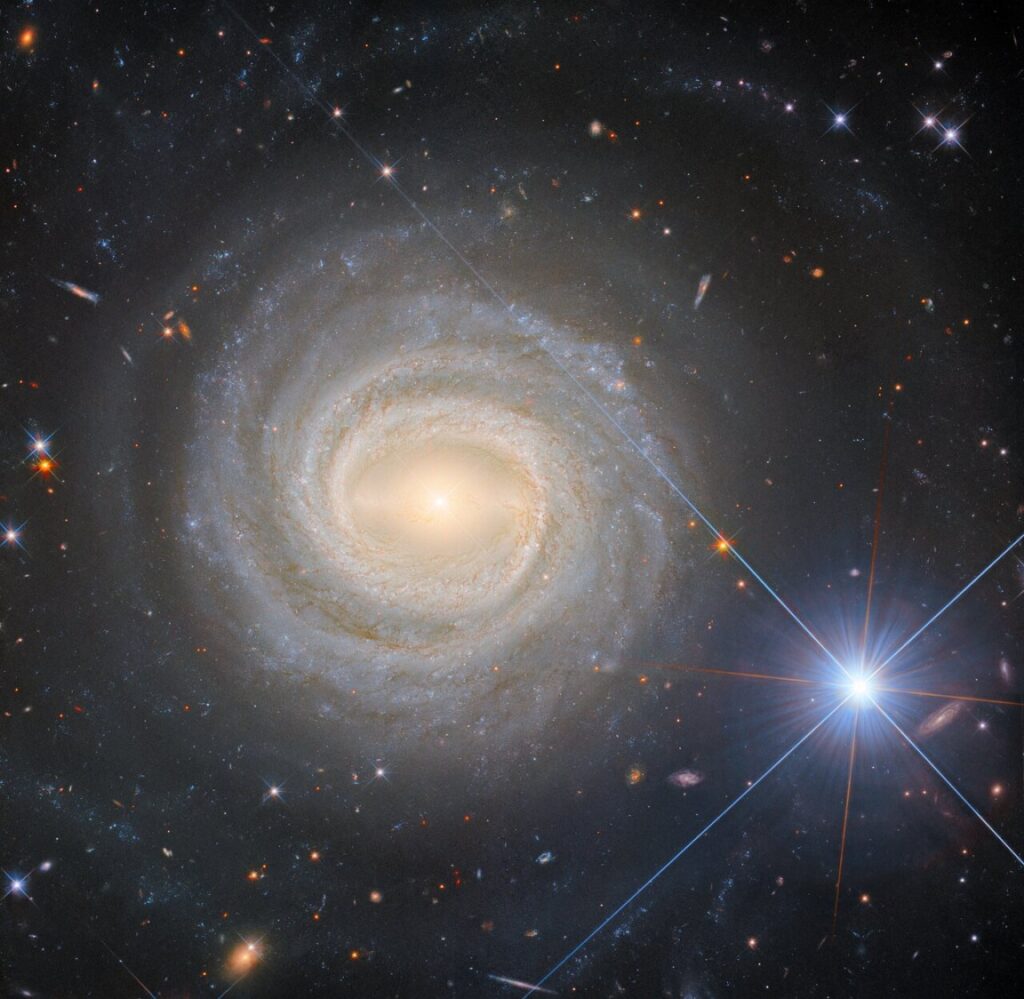
Galaxy NGC 3783
Galaxy NGC 3783 | Credit: ESA/Hubble & NASA, M. C. Bentz, D. J. V. Rosario 

The black hole tips the scales at 28 million solar masses and was already known for flickering X-ray activity. During the 10-day XRISM exposure—the longest continuous observation the mission has made—the team also detected softer X-ray peaks that coincided with the wind’s launch, indicating the flare and outflow are causally linked.

Co-author Erik Kuulkers (ESA) says the discovery shows “solar and high-energy physics may work in surprisingly familiar ways throughout the Universe.” The result strengthens the idea that super-massive black holes can regulate star formation in their host galaxies by expelling gas, a feedback process previously inferred only from slower, radiation-driven winds.

Seven satellites—XRISM, XMM-Newton, NuSTAR, Chandra, Swift, NICER and Hubble—monitored the galaxy simultaneously, mapping the wind’s velocity, ionisation and distance from the black hole (about 50 times its event-horizon radius). The team concludes that magnetic, not radiative, forces dominate the acceleration, offering a new laboratory for studying extreme plasma physics.

Future XRISM observations will test whether such flare-triggered UFOs are common or require special conditions, refining models of how galaxies and their central black holes co-evolve.


Also Read Loading title…

TAGGED: Astrophysics, Black Holes, Space
Share this Article
Facebook Twitter Copy Link Print
Leave a comment Leave a comment

Leave a Reply Cancel reply

Your email address will not be published. Required fields are marked *

Latest Posts

Attackers Exploit ChatGPT and Grok to Push AMOS Malware to Macs
Cybersecurity

Cybercriminals Exploit ChatGPT and Grok Chats to Spread AMOS Malware to Macs

Anita Sen Anita Sen December 11, 2025
Astronomy

NASA Loses Contact with MAVEN Mars Orbiter After 11 Years in Operation

Owen Parker Owen Parker December 11, 2025
McDonald’s removed a 45-second AI-generated festive advert depicting holiday mishaps after strong negative feedback from viewers.
AI

McDonald’s Pulls AI-Generated Christmas Ad After Viewers Mock ‘Creepy’ Footage

Rohit Mishra Rohit Mishra December 10, 2025
OpenAI, Anthropic and Block Unite to Launch ‘Agentic AI Foundation’ to Set Standards for AI Agents
AIProgramming

OpenAI, Anthropic and Block Unite to Create the ‘Agentic AI Foundation’ to Set Standards for AI Agents

Dev Mehta Dev Mehta December 10, 2025
Artist’s impression of high-speed gas being expelled from the centre of a supermassive black hole.
Astrophysics

Black Hole Ejects Winds at 20% Light Speed in Solar-Like Magnetic Event

Anita Sen Anita Sen December 9, 2025
EngineAI CEO Knocked Down by Own Robot to Prove It’s ‘Not CGI’
AI

EngineAI CEO Knocked Down by Own Robot to Prove It’s ‘Not CGI’: Video

Owen Parker Owen Parker December 9, 2025
Show More

© 2025 Techoreon. All rights reserved.

  • Home
  • Privacy Policy
  • Contact Us
  • About Us
  • Cookie Policy
  • Terms and Conditions
  • DMCA & Copyright Notice

Removed from reading list

Undo
Welcome Back!

Sign in to your account

Lost your password?