




Google is testing a new way to browse the web—one that doesn’t revolve around juggling dozens of tabs. On Thursday, the company unveiled Disco, an experimental Gemini-powered browser that can turn whatever you’re researching into a custom, interactive web app.
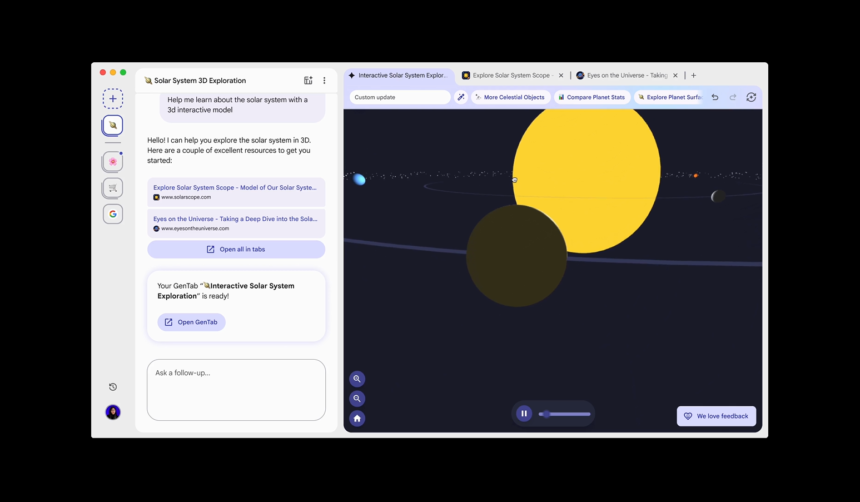
At the center of Disco is GenTabs, a new feature that uses Google’s Gemini 3 model to study the tabs you have open, your chat history, and your written prompts, then builds tools on the fly to help you get things done.
In practice, a GenTab behaves less like a traditional browser tab and more like a mini-app assembled from the information you’re viewing. If you’re planning a trip, it can combine your flight searches, hotel lists, weather pages, and travel blogs into a single dashboard with maps, itineraries, checklists, and links to the original sources.
If you’re studying, it can turn reference websites into flashcards, diagrams, or interactive models. You can refine or rebuild the app at any time with natural language.
Google says the goal is to shift the browser from a passive window into an active helper. Instead of users switching endlessly between pages, Disco analyses all the information in context and reacts to it, adding new insights as you continue browsing. It’s more collaborative than a standard chatbot: you can open new tabs yourself, and GenTabs will instantly weave those into the app it’s constructing.
The concept began as a hackathon project inside Google and has since grown into a full Labs experiment. Parisa Tabriz, who leads the Chrome team, stresses that Disco isn’t a replacement for Chrome. Instead, it’s intended as a sandbox for exploring what might come next. She describes Disco as a “discovery vehicle” that helps transform fragmented browsing sessions into personalised tools built on demand.
Gemini 3’s ability to generate one-off interactive interfaces is key. Rather than returning just text or images, the model can build functional widgets—calculators, itinerary planners, visual guides, even basic 3D models.
In one internal demo, GenTabs created an anatomy explainer with a simple interactive foot model after opening medical pages. Another example generated a cross-country moving planner, complete with price comparisons and a weight calculator.
How permanent these AI-generated apps should be is still an open question. Testers have already asked for ways to share GenTabs, save them, or export pieces into tools like Docs or Sheets. Google says it’s considering both short-lived and persistent options as it learns how people use the system.
Disco arrives at a time when the “AI browser” space is heating up. Competitors like Arc and Perplexity are experimenting with summarisation-heavy interfaces, while OpenAI is exploring its own agentic browsing tools. Google’s pitch is different: rather than simply summarising content, Disco tries to help people build things—no coding required.
For Google, it’s also a notable shift in strategy. Chrome still dominates the global browser market and remains a central pathway to Alphabet’s advertising business. Rethinking the browser interface carries obvious risks, which is why Disco is being released slowly through Google Labs, with access beginning on macOS via waitlist.
Despite its experimental status, Google hints that the ideas behind Disco could later surface elsewhere in the company’s ecosystem. “The most compelling ideas may eventually find their way into larger Google products,” the company says. GenTabs is described as just the first of several features planned for the new platform.
The launch comes as Google pushes aggressively in the AI race. Gemini 3, which powers Disco, debuted earlier this month to strong reviews, and the company has been expanding Gemini integration across its products.
The model’s “Deep Think” reasoning mode is designed to handle multi-step tasks, like synthesising meal plans from several recipe websites or pulling structured data from scattered sources, with more accuracy than previous versions.
Google’s scale also gives it advantages: Gemini 3 was trained on its in-house Tensor chips, avoiding some of the supply-chain constraints affecting rivals.
Disco is still early, but for a browser born as a side project, it represents one of Google’s boldest attempts yet to rethink what browsing should feel like in an AI-native era. Whether users will embrace “vibe-coded,” one-off web apps—or whether GenTabs eventually evolves into a part of Chrome itself—is exactly what this experiment is meant to find out.