




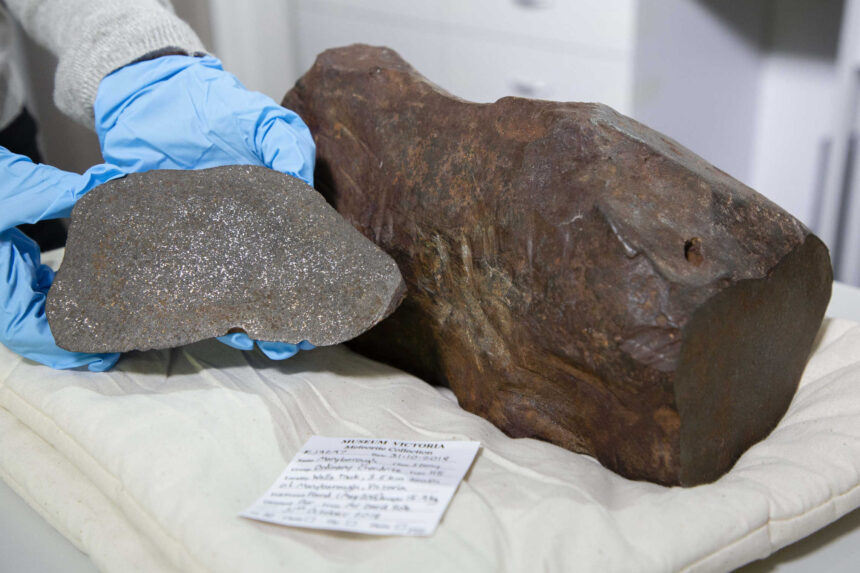
A heavy rock discovered by a gold prospector, which resisted sledgehammers, acid and drills for years, proved to be a rare meteorite dating back to the birth of the solar system.
In May 2015, David Hole was prospecting with a metal detector in the Maryborough Regional Park, near Melbourne. While searching in an ironbark forest approximately two kilometres from the town of Maryborough, he discovered a reddish, 17‑kg rock resting in yellow clay.
Believing the object contained a valuable gold nugget inside, Mr Hole took the specimen home. Over the following years, he attempted to crack it open using a rock saw, an angle grinder, a drill, and a douse of acid. He even struck the object with a sledgehammer, but the rock remained intact.
In 2018, still seeking an explanation, Mr Hole transported the object to Museums Victoria in Melbourne for identification. The specimen measured 38.5cm by 14.5cm by 14.5cm and weighed 17 kilograms (37.5lb).
Dermot Henry, the museum’s Head of Sciences, and Bill Birch, Emeritus Curator in Geosciences, examined the find. Mr Henry noted the rock possessed a “sculpted, dimpled look,” formed as the exterior melted while travelling through Earth’s atmosphere.
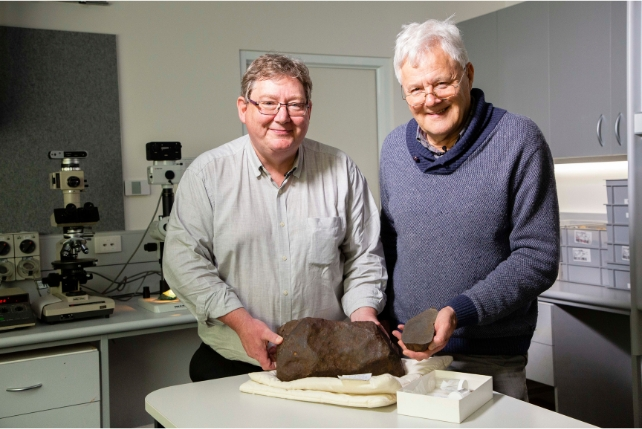
“I’ve looked at a lot of rocks that people think are meteorites,” Mr Henry said. In his 37 years at the museum, examining thousands of candidate rocks, this was only the second genuine meteorite presented to him.
“If you saw a rock on Earth like this, and you picked it up, it shouldn’t be that heavy,” Mr Birch added.
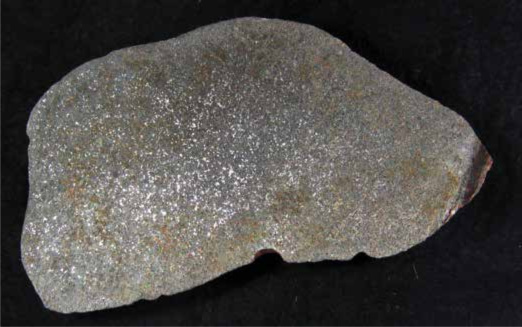
To determine its composition, researchers removed a small slice using a diamond saw, reducing the current mass to 15.9 kilograms. Microprobe analysis confirmed the object was an H5 ordinary chondrite. The “H” classification indicates a high iron content, while “5” denotes it is a highly metamorphosed chondrite, meaning it was altered by heat on its parent asteroid but preserved its original textures.
The rock is composed of crystallised metallic droplets known as chondrules, measuring up to one millimetre across. These formed via the flash heating of dust clouds in the early solar system 4.6 billion years ago. The matrix contains plagioclase, olivine, and orthopyroxene—silicate minerals rich in magnesium and iron.
Also Read: Earth Has Tilted 31.5 Inches Since 1993 — and It’s Because of Us
Crucially, the meteorite contains significant amounts of the iron-nickel phases kamacite and taenite. This metallic composition explains why the rock triggered Mr Hole’s metal detector and why it is so dense.
Geologists believe the meteorite originated in the asteroid belt between Mars and Jupiter. Unlike many meteorites that carry scars from violent impacts, the Maryborough specimen lacks high-pressure features, suggesting it had a relatively “tranquil” history before landing on Earth.
Radiocarbon (C14) dating indicates the meteorite has been on Earth for between 100 and 1,000 years. It shows signs of “incipient weathering,” consistent with a moderate time spent in a forest environment. While researchers could not confirm an exact arrival date, local news archives recorded multiple meteor sightings in the Maryborough district between 1889 and 1951.
The discovery is significant for the region. It is only the third H5 meteorite recorded in Victoria and the second-largest chondritic mass ever found in the state. The last meteorite found in Victoria was an iron-nickel specimen discovered at Willow Grove in 1995. The most recent formal description prior to this was the Ballarat meteorite, a ‘fossil’ meteorite found in river gravels in the 1860s but only confirmed in 2002.
Mr Henry highlighted the scientific value of the discovery. “Meteorites provide the cheapest form of space exploration,” he said. “They transport us back in time, providing clues to the age, formation and chemistry of our Solar System.”
He noted that some meteorites contain ‘stardust’ older than the solar system, shedding light on how stars form elements of the periodic table, while others contain amino acids, the building blocks of life.
“When you consider all the events this chunk of rock has experienced since its formation 4.6 billion years ago, it’s really mind-boggling that we get the opportunity to hold it and study it today,” Mr Birch said.
The full description of the Maryborough meteorite was published on July 17, 2019, in the Proceedings of the Royal Society of Victoria. The specimen has joined the Museums Victoria collection, which holds over 400 meteorites, including the famous Murchison meteorite.