





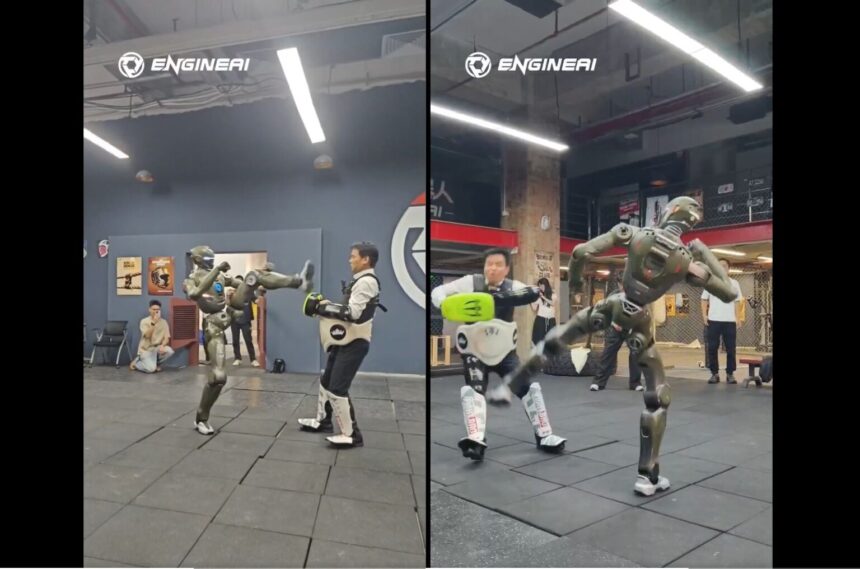
Chinese start-up EngineAI has published footage of its T800 humanoid kicking chief executive Zhao Tongyang in the torso and flooring him, a stunt it says was performed to prove the robot is “not CGI” after online scepticism greeted earlier martial-arts clips.
Zhao appeared in the video standing opposite the company’s android while wearing a heavy suit of protective armour. The demonstration, which went viral shortly after its release, depicted the robot executing martial arts movements against the executive.
In the footage, the T800 squares up to Zhao. The robot’s initial kick misses its target as the CEO backs away, with a caption on the video noting that he “barely avoided kissing the sole of T800’s feet”.
The subsequent strike connects directly with Zhao’s torso, sending him flying to the ground.
“Too violent. Too brutal,” a shell-shocked Zhao said after the impact. “Without protective gear, no one could withstand it. Anyone would break a bone.”
He jokingly added: “I can’t guarantee I’ll stay alive after the next test.”
Dispelling CGI Rumours
EngineAI released the video specifically to rebut claims from social media users that its previous promotional materials were faked using CGI. The stunt was performed to demonstrate that the T800 is a physical entity capable of executing complex movements and interacting with a human, rather than an animation.
75kg class head-on brawl! EngineAI T800 kicks the boss: Is this kick personal?#EngineAI #robotics #newtechnology #newproduct pic.twitter.com/UCRrP0qBaz
— EngineAI (@engineairobot) December 6, 2025However, the company has never claimed that the T800 is fully autonomous, but rather a model capable of executing programmed movements with precision.
EngineAI was founded in October 2023 and comprises former members of robotics teams linked to China’s electric vehicle industry. Zhao has stated that his vision is for humanoid robots to enter homes and perform everyday tasks.
The company previously introduced the SA01, a low-cost bipedal robot with a retail price of 38,500 yuan (£4,200). It also developed the SE01, a full-sized model standing 170cm tall and weighing 55kg. The SE01 features 32 degrees of freedom and a top speed of two metres per second. It utilises neural networks to optimise its gait, allowing for long strides rather than the short steps common in other bipedal machines.
The stunt by EngineAI follows a trend of robotics firms using martial arts to showcase agility. Earlier this year, Chinese company Unitree demonstrated its G1 humanoid performing kung-fu moves. In October, Elon Musk posted a video of Tesla’s Optimus robot fighting in a simulated bout, claiming it was learning Kung Fu.
Industry analysts note that such demonstrations often face scepticism regarding “teleoperation”—where a human controls the robot remotely—or the use of pre-programmed sequences rather than genuine autonomy. While the video suggests the robot is not a digital fabrication, no independent laboratory or university has verified the machine’s autonomy, stability, or battery life.
Observers on platforms such as Reddit have suggested the movements could be choreographed or reliant on motion capture technology.
The test has also highlighted safety concerns regarding these powerful androids designed to work alongside humans. The issue disrupted the US industry last month when a former safety engineer at the robotics firm Figure AI sued his employer. The lawsuit alleged he was fired after warning that the robots were “powerful enough to fracture a human skull”. The suit also detailed an incident where a Figure bot malfunctioned and gashed a stainless steel fridge door, narrowly missing an employee.
Currently, EngineAI has not released a full datasheet or independent test data for the T800 model featured in the video.