





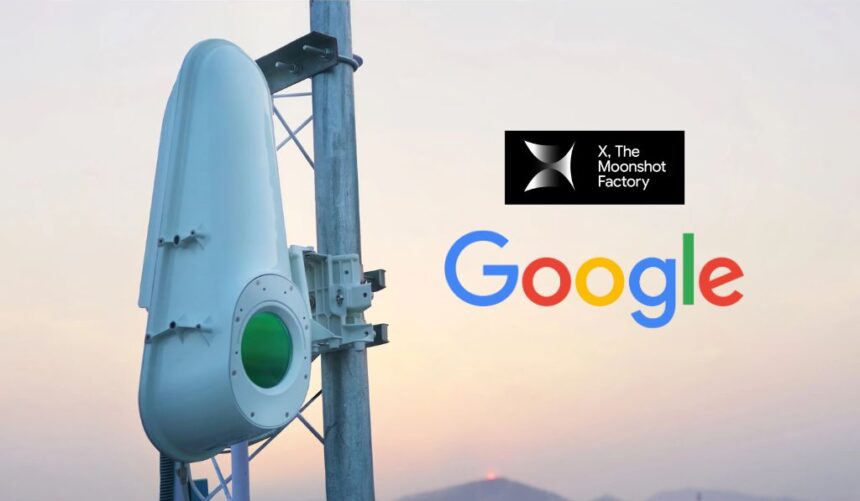
In an attempt to overcome the limitations of traditional internet infrastructure, Alphabet, Google ‘s parent company, has developed a laser-based solution. Taara, as it’s called, has already been successfully implemented on a 5-kilometer link connecting the cities of Brazzaville and Kinshasa, located in the Democratic Republic of the Congo.
This breakthrough is set to improve connectivity in remote areas while putting Google in direct competition with Starlink, Elon Musk ‘s satellite internet service, which until recently was the benchmark in this type of development.
What is Google’s internet connection solution?
Taara is a project developed by X Company, the Alphabet division dedicated to creating technologies that help solve global problems. This system uses extremely narrow light beams to transmit data between terminals, eliminating the need for cables.
Taara’s units, which are comparable in size to a traffic light, can send information at speeds of up to 20 gigabits per second over distances of up to 20 kilometers. All this is achieved with minimal power consumption, equivalent to a 40-watt light bulb.
Why it can be an alternative to fiber optics in difficult terrain
Taara’s main attraction lies in its ability to offer connectivity in locations where installing fiber optics is difficult or expensive. This includes densely populated areas, rugged terrain, or regions separated by rivers.
By eliminating cabling, Taara not only significantly reduces installation costs, but also eliminates the hassles associated with obtaining right-of-way permits, a common requirement for fiber deployment.
Furthermore, the system allows installation to be completed in a matter of hours, as opposed to the long periods typically required by traditional methods. This speed and efficiency could make Taara a practical solution for bridging the digital divide in remote or developing communities.
How Tara implements laser technology to expand global connection
Taara uses similar principles to fiber optics, as both systems use light to transport data. However, while fiber optics requires physical cables to transmit information, Taara makes it simpler by being wireless.
This process is achieved by creating a link between two Taara units, which emit invisible and highly precise light beams.
Additionally, each Taara Lightbridge unit is equipped with advanced technology that maintains beam alignment, even under challenging conditions such as wind or building movement.
This design ensures stable and reliable data transmission, which is crucial to ensuring a satisfactory user experience.
Why it’s a direct competitor to Elon Musk’s internet
Taara’s deployment could be a direct competitor to Starlink, the satellite internet service developed by Elon Musk’s SpaceX. While Starlink uses a network of orbiting satellites to provide connectivity, Taara offers a terrestrial alternative that doesn’t rely on satellite infrastructure.

Although both developments aim to bring internet to remote areas, Taara stands out for its low energy consumption and its ability to offer transmission speeds comparable to fiber optics.
The aforementioned features could make Taara a more attractive option in certain contexts, especially in regions where satellite deployment is unfeasible or very expensive.
The important thing is that as this type of development expands, it will help people in territories lacking good connectivity, closing the digital divide and increasing their opportunities for advancement.