


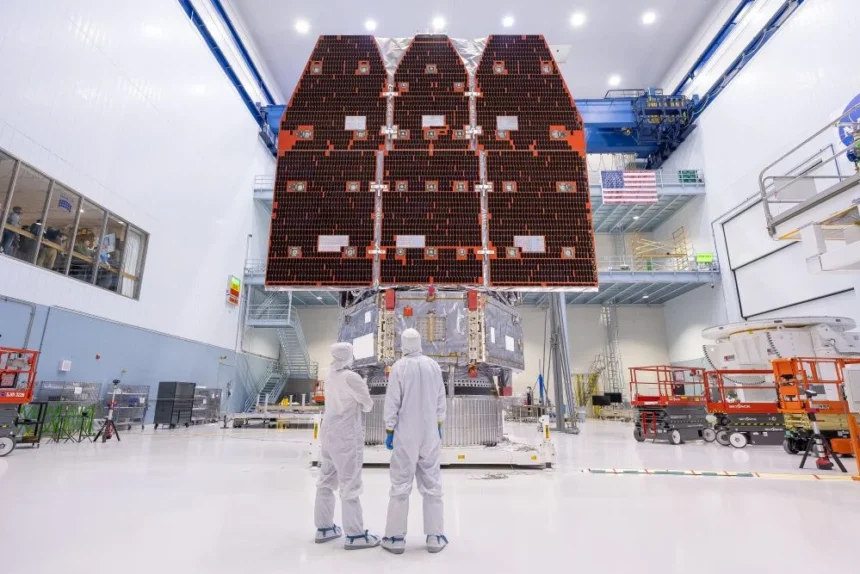
NASA has finished assembling the Nancy Grace Roman Space Telescope, moving it closer to launch, which could happen as early as late 2026. On 25 November, engineers connected the telescope’s two main sections inside the largest clean room at NASA’s Goddard Space Flight Center in Greenbelt, Maryland, following a long series of tests meant to prove the hardware can survive both the launch and the conditions of space.
Before the final assembly, each part of the telescope went through its own set of demanding tests. The outer section of the observatory was shaken on vibration tables to mimic the forces of liftoff, and blasted with loud acoustic levels with the kind of noise produced by a rocket launch.
Meanwhile, the inner section—which holds the telescope’s optics, instruments, and spacecraft bus—completed a 65-day thermal vacuum test. This test exposed the hardware to extreme hot and cold cycles and the vacuum of space it will experience. According to NASA, the inner section performed exactly as expected.
“We want to make sure Roman will withstand our harshest environments,” said Rebecca Espina, a deputy test director at Goddard.
Now that the full observatory is assembled, it will begin an extended round of environmental and performance testing under simulated space conditions. After this phase, Roman will be shipped to NASA’s Kennedy Space Center in Florida this summer, where it will go through final checks and be prepared for launch.
What Roman Will Do
Roman is an infrared telescope built to tackle big questions about dark energy, exoplanets, and the structure of the universe. It carries two main instruments: the Wide-Field Instrument (WFI) and the Coronagraph Instrument (CGI).
The WFI includes a 288-megapixel camera with a field of view 100 times larger than the Hubble’s, while still offering similar resolution. The CGI uses masks, filters, and tiny self-adjusting mirrors to block out starlight so it can directly image nearby exoplanets and the disks where planets form. It will be the first active coronagraph ever flown in space.
“The question of ‘Are we alone?’ is a big one, and it’s an equally big task to build tools that can help us answer it,” said Feng Zhao, who manages the Roman Coronagraph Instrument at NASA’s Jet Propulsion Laboratory. “The Roman Coronagraph is going to bring us one step closer to that goal.”
Unlike some infrared telescopes that need coolant, Roman uses fuel to maintain its orbit and pointing, similar to the James Webb Space Telescope. Its main mission is planned for five years, though it could run longer.
What Scientists Expect
Roman is expected to collect about 20,000 terabytes (20 petabytes) of data in its first five years. Researchers estimate it could spot more than 100,000 distant planets, billions of galaxies, huge numbers of stars and supernovae. It will also help detect isolated black holes using gravitational microlensing.
“With Roman’s construction complete, we are poised at the brink of unfathomable scientific discovery,” said Julie McEnery, the mission’s senior project scientist.
One of Roman’s biggest goals is to help explain why the universe’s expansion is speeding up—something currently linked to dark energy.
“Within our lifetimes, a great mystery has arisen about the cosmos: why the expansion of the universe seems to be accelerating,” said Nicky Fox, associate administrator of NASA’s Science Mission Directorate. “There is something fundamental about space and time we don’t yet understand, and Roman was built to discover what it is.”
Launch Plans
Roman is set to launch on a SpaceX Falcon Heavy rocket and travel to the Sun–Earth Lagrange Point 2 (L2), about a million miles from Earth. The official target is May 2027, though NASA says the telescope could be ready as early as fall 2026.
The project has continued to move forward despite political uncertainty. The current U.S. administration has threatened to cancel the nearly completed observatory, even though billions of dollars have already been spent. For now, work continues.
“Completing the Roman observatory brings us to a defining moment for the agency,” said NASA Associate Administrator Amit Kshatriya. “Transformative science depends on disciplined engineering, and this team has delivered—piece by piece, test by test.”
Jackie Townsend, Roman’s deputy project manager, added that the data the mission collects will fuel discoveries “for decades to come,” continuing the legacy of Dr. Nancy Grace Roman, the telescope’s namesake, often called the “Mother of Hubble.”