



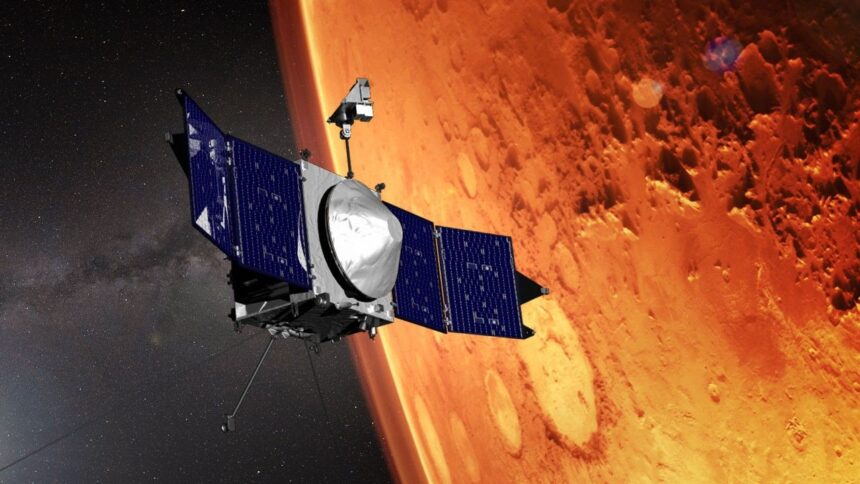
NASA has lost contact with MAVEN, a spacecraft that has orbited Mars for more than a decade and is one of only three active US satellites circling the planet.
The agency said on Tuesday that communications with the Mars Atmosphere and Volatile EvolutioN mission stopped on Sunday. Telemetry showed the orbiter functioning normally before it moved behind Mars as seen from Earth, but contact did not return when it reappeared.
NASA said engineering and operations teams are investigating the anomaly. The agency added that more information will be released when available. Operators at the Deep Space Network and the Jet Propulsion Laboratory in California are continuing to send signals along the spacecraft’s predicted orbit while they work to identify the cause.
MAVEN switched to an all-stellar navigation system in 2022 to reduce reliance on its inertial measurement units. NASA said the orbiter has enough propellant to remain in operation at least through the end of the decade, although it is already performing well beyond its original mission. The spacecraft’s operating cost for 2024 was $22.6 million.
Weighing 5,410 pounds at launch, MAVEN lifted off from Cape Canaveral on 18 November 2013 aboard a United Launch Alliance Atlas V rocket. Its dry mass without fuel was 1,784 pounds. After travelling 442 million miles, it entered Mars orbit on 21 September 2014.
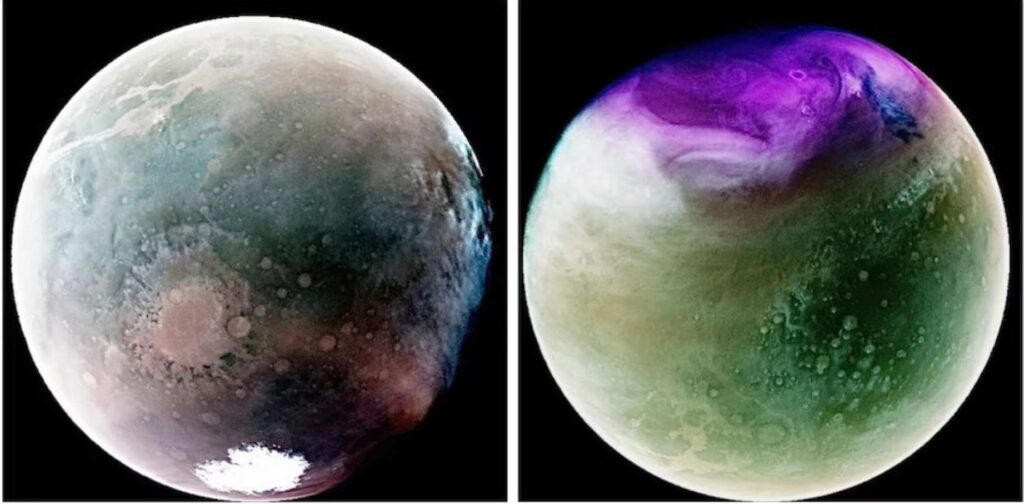
The mission was designed to study the planet’s upper atmosphere, ionosphere and interactions with the Sun and solar wind to understand how Mars lost much of its atmosphere over time. Findings from MAVEN and other missions have supported the conclusion that the Sun gradually stripped away the Martian atmosphere, transforming the planet from a warmer world capable of supporting liquid water into a cold, arid environment.
Alongside its scientific work, MAVEN serves as a communications relay for NASA’s Curiosity rover, which landed in 2012, and the Perseverance rover, which arrived in 2021. NASA’s older orbiters—the Mars Odyssey spacecraft, operating since 2001, and the Mars Reconnaissance Orbiter, operating since 2006—also support relay functions.
Four other non-US orbiters are currently circling Mars: the European Space Agency’s Mars Express, launched in 2003; the ESA–Roscosmos ExoMars Trace Gas Orbiter, launched in 2016; the UAE Space Agency’s Hope mission, which arrived in 2021; and China’s Tianwen-1, which entered orbit one day later.
Two small NASA ESCAPADE satellites, launched on a Blue Origin New Glenn rocket on 13 November, are expected to reach Mars in September 2027 on a longer-than-usual trajectory.