

Techoreon

  • Home
  • AI
  • Tips & Tricks
  • Info
    • Privacy Policy
    • DMCA & Copyright Notice
    • Contact Us
    • About Us
    • Cookie Policy
    • Terms and Conditions
Notification Show More
Latest News
Google Disco, GenTabs, Gemini 3, AI browser, Google Labs, web apps
Google Unveils ‘Disco,’ a Gemini-Powered AI Browser That Turns Tabs into Interactive Apps
Google AI
Attackers Exploit ChatGPT and Grok to Push AMOS Malware to Macs
Cybercriminals Exploit ChatGPT and Grok Chats to Spread AMOS Malware to Macs
Cybersecurity
NASA Loses Contact with MAVEN Mars Orbiter After 11 Years in Operation
Astronomy
NASA’s Nancy Grace Roman Space Telescope
NASA Completes Roman Space Telescope, Designed to Map the Cosmos at 100x Hubble’s Scale
Astronomy
McDonald’s removed a 45-second AI-generated festive advert depicting holiday mishaps after strong negative feedback from viewers.
McDonald’s Pulls AI-Generated Christmas Ad After Viewers Mock ‘Creepy’ Footage
AI
Aa

Techoreon

Aa
  • Home
  • AI
  • Tips & Tricks
Search
  • Home
  • Privacy Policy
  • Contact Us
  • About Us
  • Cookie Policy
  • Terms and Conditions
  • DMCA & Copyright Notice
Follow US
Techoreon > Astrophysics > Two Black Holes Caught on Camera Orbiting Each Other for the First Time
Astrophysics

Two Black Holes Caught on Camera Orbiting Each Other for the First Time

Anita Sen
Last updated: 2025/10/12 at 10:51 AM
Anita Sen
Share
6 Min Read
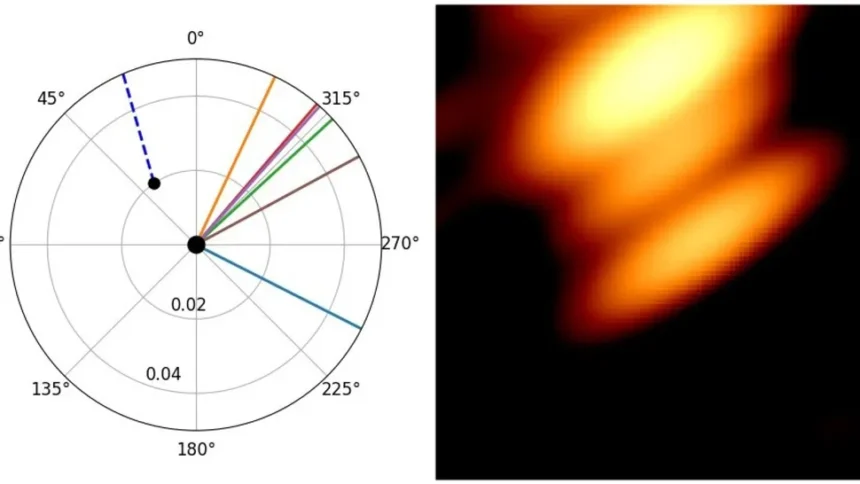
Diagram (left) showing the black holes and their jets at the time of observation, next to the radio image (right).
The two black holes orbiting in the centre of OJ287, a quasar located 5,000 million light-years from Earth | Credit: arXiv (2025). DOI: 10.48550/arxiv.2510.06744
SHARE

For the first time, an international team managed to capture an image showing two black holes orbiting one another, a result that offers visual proof of a phenomenon previously inferred only via indirect observations. The discovery was made in the core of the quasar OJ287, located about 5 billion light-years from Earth.

The research was led by Mauri Valtonen, an astronomer at the University of Turku (Finland), together with an international consortium, and published in The Astrophysical Journal. The scientists emphasised that this achievement was possible by combining observations made on Earth and in space using a network of radio telescopes.

How the Image Was Obtained and Why It Matters

The team employed radio imaging technology, combining data from terrestrial telescopes and the Russian satellite RadioAstron, whose radio telescope extended to nearly half the distance to the Moon. This reach allowed an unprecedented resolution, sufficient to distinguish two separated sources near the intense glow characteristic of quasars.
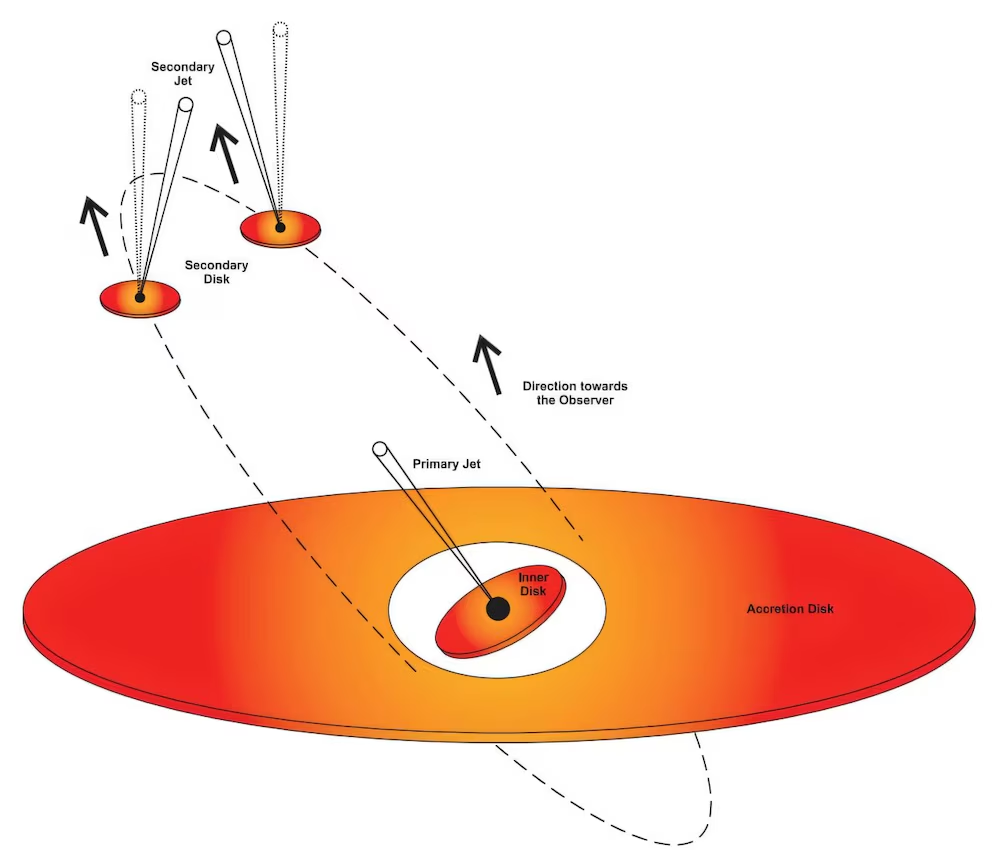
Black holes and their particle jets offer fundamental clues about the dynamics of the cosmos’ most massive objects. | Credit: arXiv (2025). DOI: 10.48550/arxiv.2510.06744

“In the image, the black holes are identified by the intense particle jets they emit. The black holes themselves are perfectly black, but they can be detected by these particle jets or by the glowing gas surrounding the hole,” explained Valtonen.

OJ287, known for its exceptional luminosity, had long aroused suspicion within the astronomical community due to its pattern of brightness variations at roughly 12-year intervals. For more than forty years, hundreds of astronomers monitored those regular fluctuations, suspecting that they were caused by two black holes in mutual orbit.

The History Behind OJ287 and the Road to Visual Confirmation

The first images of the region now associated with OJ287 date back to the late 19th century, long before the existence of black holes was even considered plausible. The object came under intensive study in the 1980s by researchers at the University of Turku, after astronomer Aimo Sillanpää identified regular variations in brightness and proposed the theory of a binary black hole pair.

Recent advances refined the predicted orbit and estimated physical parameters, but visual confirmation remained elusive. The NASA satellite TESS detected light emissions from both objects, albeit as a single point, insufficient to resolve them individually.

Meanwhile, the newly obtained image of the two orbiting black holes marks a significant milestone, linking a longstanding astrophysical hypothesis to observable evidence. “For four decades we wondered if it would be possible to detect them at the same time. Finally, the proof is in view,” said Valtonen.


Also Read Loading title…
TAGGED: Astronomy, Astrophysics, Black Hole
Share this Article
Facebook Twitter Copy Link Print

Latest Posts

Google Disco, GenTabs, Gemini 3, AI browser, Google Labs, web apps
GoogleAI

Google Unveils ‘Disco,’ a Gemini-Powered AI Browser That Turns Tabs into Interactive Apps

Owen Parker Owen Parker December 12, 2025
Attackers Exploit ChatGPT and Grok to Push AMOS Malware to Macs
Cybersecurity

Cybercriminals Exploit ChatGPT and Grok Chats to Spread AMOS Malware to Macs

Anita Sen Anita Sen December 11, 2025
Astronomy

NASA Loses Contact with MAVEN Mars Orbiter After 11 Years in Operation

Owen Parker Owen Parker December 11, 2025
NASA’s Nancy Grace Roman Space Telescope
Astronomy

NASA Completes Roman Space Telescope, Designed to Map the Cosmos at 100x Hubble’s Scale

Anita Sen Anita Sen December 10, 2025
McDonald’s removed a 45-second AI-generated festive advert depicting holiday mishaps after strong negative feedback from viewers.
AI

McDonald’s Pulls AI-Generated Christmas Ad After Viewers Mock ‘Creepy’ Footage

Rohit Mishra Rohit Mishra December 10, 2025
OpenAI, Anthropic and Block Unite to Launch ‘Agentic AI Foundation’ to Set Standards for AI Agents
AIProgramming

OpenAI, Anthropic and Block Unite to Create the ‘Agentic AI Foundation’ to Set Standards for AI Agents

Dev Mehta Dev Mehta December 10, 2025
Show More

© 2025 Techoreon. All rights reserved.

  • Home
  • Privacy Policy
  • Contact Us
  • About Us
  • Cookie Policy
  • Terms and Conditions
  • DMCA & Copyright Notice

Removed from reading list

Undo
Welcome Back!

Sign in to your account

Lost your password?